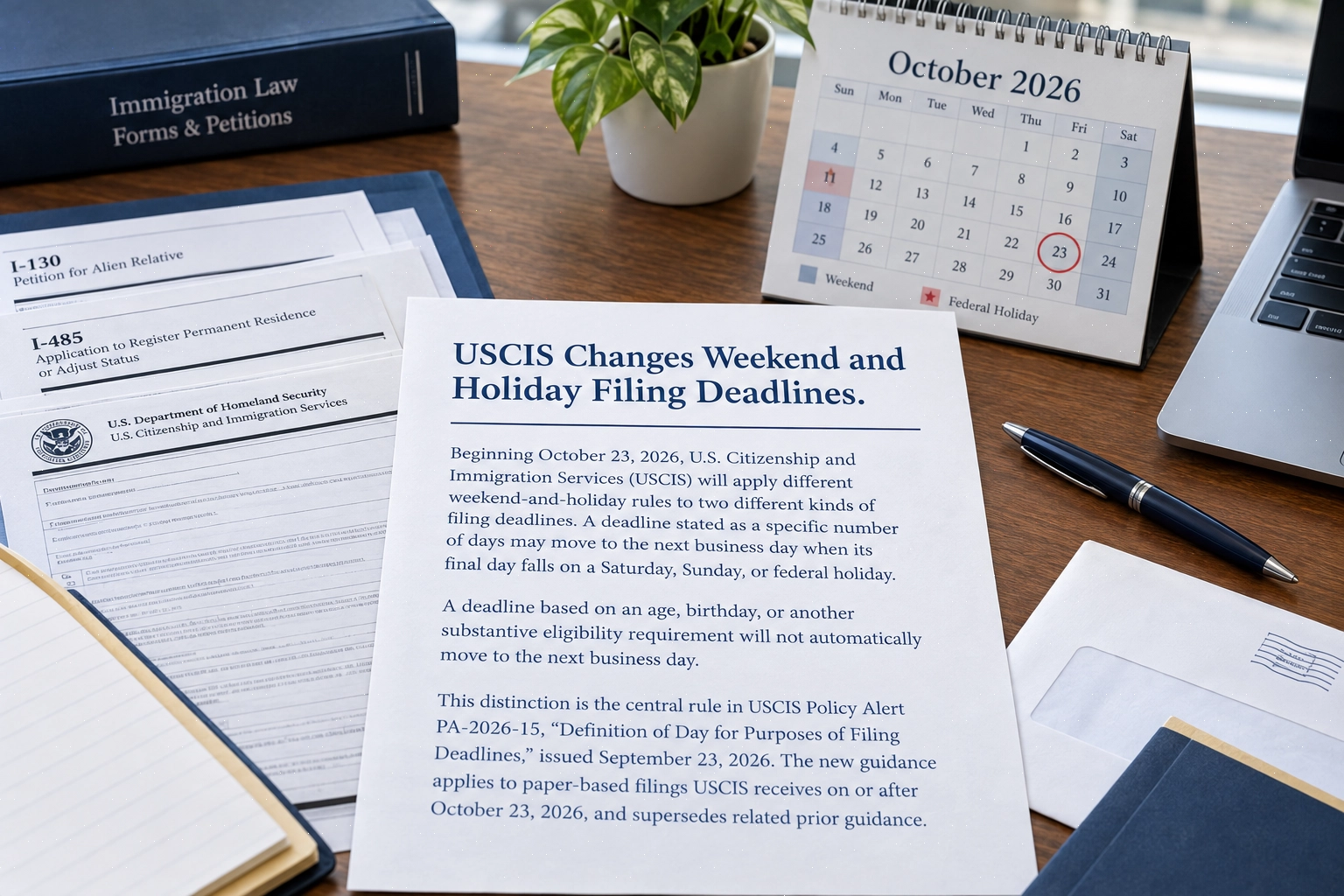
USCIS Changes Weekend and Holiday Filing Deadlines

Beginning October 23, 2026, U.S. Citizenship and Immigration Services (USCIS) will apply different weekend-and-holiday rules to two different kinds of filing deadlines. A deadline stated as a specific number of days may move to the next business day when its final day falls on a Saturday, Sunday, or federal holiday. A deadline based on an age, birthday, or another substantive eligibility requirement will not automatically move to the next business day.
This distinction is the central rule in USCIS Policy Alert PA-2026-15, “Definition of Day for Purposes of Filing Deadlines,” issued September 23, 2026. The new guidance applies to paper-based filings USCIS receives on or after October 23, 2026, and supersedes related prior guidance.
Agency: U.S. Citizenship and Immigration Services
Policy alert: PA-2026-15
Issued: September 23, 2026
Effective date: October 23, 2026
Applies to: Paper-based filings received on or after the effective date
Policy Manual section: Volume 1, Part B, Chapter 6, Section E
Source: Official USCIS policy alert
The New USCIS Rule in Plain Language
The phrase “next business day” does not apply to every USCIS deadline that happens to fall on a weekend or federal holiday. The controlling question is how the statute, regulation, or form instructions define the deadline.
| Type of deadline | Rule beginning October 23, 2026 | General example |
| A period stated as a specific number of days | If the last day falls on a Saturday, Sunday, or federal holiday, a qualifying paper filing received by the end of the next business day is treated as timely. | A paper appeal must be filed within 30 or 33 days. |
| A cutoff based on an age, birthday, or substantive eligibility requirement, rather than a period of days | The cutoff does not move merely because it falls on a weekend or federal holiday. | An SIJ petitioner must be under 21 when filing Form I-360. |
| An electronic filing | USCIS considers it received when it is submitted. USCIS does not extend the period merely because the deadline falls when offices do not accept paper deliveries. | A form available for online filing should be submitted electronically by the applicable deadline. |
The distinction is technical, but the consequences can be significant. A filing received on Monday may be timely when the governing rule provides a 30-day period ending on Saturday. The same Monday receipt may be too late when eligibility required USCIS to receive the filing before a 21st birthday that occurred on Saturday.
Which Deadlines Still Receive the Next-Business-Day Extension?
The extension continues when a statute, regulation, or USCIS form instruction creates a filing or response period using a specified number of days.
The governing regulation, 8 C.F.R. § 1.2, generally counts Saturdays, Sundays, and legal holidays when computing a period. If the final day falls on one of those days, however, the period continues through the end of the next day that is not a Saturday, Sunday, or legal holiday.
PA-2026-15 uses two familiar examples:
- A person generally has 30 days to file Form I-290B after USCIS personally serves a qualifying Form I-485 denial.
- When USCIS serves the denial by mail, the filing period is generally 33 days.
The alert illustrates the rule with a denial dated August 2, 2022. A 33-day period ended on Sunday, September 4, followed by Labor Day on Monday, September 5. A paper Form I-290B received on Tuesday, September 6—the next business day—would still be considered timely.
This rule also remains important for many response periods stated in days, including qualifying mailed responses to Requests for Evidence and notices of intent to deny, revoke, rescind, or terminate. However, a different statute, regulation, form instruction, or benefit-specific procedure may control. The policy alert expressly notes that certain benefits, including asylum matters governed by different regulations and procedures, may not follow the general rule.
Which Deadlines No Longer Move to the Next Business Day?
USCIS will not apply the regulatory definition of “day” when the deadline is not calculated as a specified period of days but instead arises from a substantive eligibility requirement.
The policy alert’s principal example is Special Immigrant Juvenile (SIJ) classification. The SIJ regulation requires a petitioner to be under 21 when Form I-360 is filed. That requirement is an age condition—not a 30-, 60-, or 90-day filing period.
Under the new policy, if an SIJ petitioner’s 21st birthday falls on a Saturday, Sunday, or federal holiday, the deadline does not move to the next business day. USCIS must receive a properly filed petition before the person turns 21. A paper filing delivered on the following Monday would not be timely merely because USCIS did not accept paper deliveries during the weekend.
The same analytical approach may apply to another filing tied to an age, birthday, status expiration, or other eligibility condition not phrased as a period of days. However, do not assume every date-based requirement follows the same rule. Review the controlling statute, regulation, form instructions, filing method, and any benefit-specific policy.
What Was USCIS’s Previous Position?
The September 2026 guidance is a return to USCIS’s pre-2023 interpretation, not the creation of an entirely new definition.
USCIS’s position before March 29, 2023
Before 2023, USCIS applied the regulatory definition in 8 C.F.R. § 1.2 to filing periods expressed in terms of days. According to PA-2026-15, the agency did not apply that definition to requirements stated differently, such as filing while under 21 or before a birthday.
Under that earlier approach, an age-based eligibility cutoff did not move simply because the birthday fell on a weekend or federal holiday.
The broader rule USCIS adopted in 2023
On March 29, 2023, USCIS issued Policy Alert PA-2023-10, “Filing Periods and Response Timeframes Ending on Saturdays, Sundays, or Federal Holidays.”
That policy expanded next-business-day treatment for paper filings. It expressly included the last day before a requestor’s or beneficiary’s birthday and the last day of another qualifying filing period. For example, if a person had to file before turning 21 and the birthday fell on a Saturday, Sunday, or federal holiday, USCIS treated a paper filing received by the end of the next business day as timely.
The 2023 guidance applied immediately to covered paper benefit requests and mailed responses pending on or received by USCIS on or after March 29, 2023. Electronic filings were treated differently because USCIS considers an electronically submitted request received immediately upon submission.
The 2026 return to the earlier interpretation
PA-2026-15 withdraws the 2023 expansion for deadlines that are not expressed in days. USCIS states that the regulatory definition never applied to birthdays and age requirements before the 2023 change and that the agency is returning to its longstanding understanding.
USCIS acknowledged that applicants, petitioners, and representatives may have planned filings in reliance on the 2023 policy. The agency nevertheless concluded that consistent application of statutes, regulations, case law, and its prior interpretation outweighed those expectations. It delayed implementation for 30 days, until October 23, 2026, to provide advance notice.
Because the new policy applies to paper filings received on or after October 23, mailing a package before that date does not necessarily place it under the earlier rule. A person approaching a weekend, holiday, or age-related cutoff should not plan around the last permissible day.
The Supreme Court Decision USCIS Cited: Monsalvo Velázquez v. Bondi
USCIS cites the Supreme Court’s 2025 decision in Monsalvo Velázquez v. Bondi, 604 U.S. 712 (2025), to support the established legal meaning of the term “day” when a deadline is expressed in days.
What happened in Monsalvo Velázquez?
Hugo Monsalvo Velázquez received 60 days to depart the United States voluntarily. Measured as ordinary calendar days, the period ended on a Saturday. He sent a motion to reopen by overnight delivery on the preceding Friday, but the Board of Immigration Appeals accepted it for filing on Monday.
The Board treated the voluntary-departure period as having expired on Saturday. The Tenth Circuit agreed. The Supreme Court reversed.
What did the Supreme Court hold?
The Court held that the statutory 60-day voluntary-departure deadline extended to the next business day when its last day fell on a weekend or legal holiday. The Court reasoned that, in immigration law and other legal settings, the word “days” has long carried a specialized meaning that allows this rollover. Immigration regulations had used that approach since at least the 1950s, and Congress legislated against that longstanding regulatory background.
The Court also rejected the government’s proposed division between “procedural” and “substantive” deadlines in the statute at issue. The statutory text used the term “days” and did not create that distinction.
What Monsalvo Velázquez did not decide
The Supreme Court did not decide when a person reaches a particular age, whether a birthday is divisible into hours, or whether an age-based USCIS eligibility requirement moves to Monday when a birthday falls on a weekend.
This is an important limit. PA-2026-15 relies on Monsalvo Velázquez for the specialized meaning of deadlines expressed in “days.” USCIS then draws a separate line for eligibility requirements that are not expressed as a period of days. The agency’s new distinction is therefore based principally on the wording of the governing requirement: a stated number of days versus an age, birthday, or other substantive eligibility condition.
Matter of Borges Borsoi and the SIJ Age Deadline
On the same date USCIS issued PA-2026-15, the agency designated Matter of Borges Borsoi, 30 I&N Dec. 67 (AAO 2026), as a published precedent decision.
The petitioner was born on March 8, 2002. A Massachusetts court entered the required SIJ-related order on March 3, 2023. She mailed Form I-360 before her birthday, but USCIS received the petition on March 8—the day she turned 21.
The Administrative Appeals Office held that:
- The SIJ petition had to be filed before the day of the petitioner’s 21st birthday;
- USCIS receipt, not the earlier mailing date, controlled the filing date; and
- The date of birth, rather than the precise hour of birth, determined whether the petitioner was under 21.
The petitioner relied in part on the Second Circuit’s derivative-citizenship decision in Duarte-Ceri v. Holder, which had considered the exact time of birth. The AAO declined to apply that reasoning to SIJ classification, explaining that Duarte-Ceri arose in a different statutory context and did not establish the rule for SIJ petitions.
Matter of Borges Borsoi and PA-2026-15 address related but distinct questions. The precedent decision establishes that an SIJ petition received on the 21st birthday is too late and that the birthday is not divided into hours. The policy alert establishes that a weekend or federal holiday does not extend that birthday-based cutoff to the next business day.
The distinction also matters factually: Borges Borsoi’s birthday fell on a Wednesday, not a weekend or federal holiday. The 2023 weekend-and-holiday policy therefore would not have made her filing timely even if it had applied to her case.
Paper Filings and Electronic Filings Follow Different Operational Rules
Paper filings
For a paper submission, USCIS generally records the date it actually receives the package at the designated filing location. The mailing date, postmark, or courier pickup date ordinarily does not become the USCIS filing date.
When a qualifying deadline is stated in days and ends on a weekend or federal holiday, USCIS may treat next-business-day receipt as timely even though the receipt notice displays the later date. When the deadline is an age or birthday requirement, the next-business-day rule does not apply merely because USCIS could not accept paper delivery on the cutoff date.
USCIS separately permits an SIJ petitioner, or the petitioner’s representative, to contact the USCIS Contact Center to request an expedited field-office appointment for in-person Form I-360 filing during the two-week period before the petitioner turns 21. The limited in-person filing procedure can reduce delivery risk in an age-out case, but it should not replace starting the state-court and immigration processes early.
Electronic filings
USCIS considers an electronically submitted request received immediately upon submission. Because online filing is not dependent on a physical office accepting a paper package, PA-2026-15 says USCIS does not use the weekend-and-holiday rule to extend the electronic filing period.
Applicants should confirm that the form and filing category are eligible for online filing. Creating a draft in an online account does not file the request. The form must be completed, signed, paid for when required, and successfully submitted according to the applicable instructions.
What Has Not Changed
The new policy does not convert USCIS filing deadlines into mailing deadlines. For most paper benefit requests, actual receipt at the designated filing location remains controlling.
It also does not protect a package that USCIS rejects as improperly filed. A rejected submission generally does not retain its original receipt date when it is corrected and resubmitted. A filing should therefore allow enough time to address an incorrect fee, missing signature, outdated form edition, wrong address, or another defect before a deadline expires.
Finally, PA-2026-15 does not establish one universal rule for every immigration filing. A more specific statute, regulation, form instruction, court rule, or benefit-specific policy may control. Do not treat deadlines involving USCIS, the Department of State, an immigration court, or the Board of Immigration Appeals as interchangeable.
Practical Steps Before Any USCIS Deadline
- Identify the source of the deadline. Determine whether it comes from a statute, regulation, form instruction, USCIS notice, or another authority.
- Read the exact wording. A deadline stated as “30 days” may operate differently from a requirement to file “before the 21st birthday” or while a particular status or condition still exists.
- Confirm whether the filing is paper or electronic. Do not assume an online option exists for every form or category.
- Use the correct filing location. USCIS addresses can differ by form, eligibility category, delivery method, and requested service.
- Do not rely on the last day. Delivery delays, rejected payments, incorrect form editions, missing signatures, and holidays can turn a planned timely filing into a late one.
- Preserve the filing record. Keep a complete copy, proof of delivery, payment records, electronic confirmation, and the USCIS receipt notice.
- Review transition-period filings carefully. The new rule applies to covered paper filings USCIS receives on or after October 23, 2026.
Why This Policy Change Matters
PA-2026-15 creates a clearer textual rule, but it removes a protection that existed under the 2023 policy for some paper filings tied to birthdays and similar eligibility cutoffs. Applicants facing an age-out deadline can no longer assume that a weekend or federal holiday provides additional time.
The safest practice is to calculate the legal deadline first and then set an earlier operational deadline for completing and delivering the filing. That buffer is especially important when eligibility may end permanently if USCIS receives the request too late.
Discuss a Deadline-Sensitive Immigration Filing With an Attorney
Immigration deadlines can determine whether USCIS has authority to approve a benefit. The wording of the governing rule, the filing method, the receipt date, and the applicant’s continuing eligibility may all affect the analysis.
The Law Offices of Osas Iyamu, LLC, located in Ocala, Florida, assists clients with federal immigration matters nationwide. A consultation with Immigration Attorney Osas Iyamu can help identify the controlling deadline and the filing requirements that apply to your circumstances.
Call, text, or WhatsApp: 352-237-2403
Office hours: Monday–Friday, 9:00 a.m.–5:00 p.m.
This article provides general information about USCIS policy and published decisions. It is not individualized legal advice and does not create an attorney-client relationship. Filing rules may vary by benefit, agency, jurisdiction, and later legal developments. Anyone facing an approaching deadline should obtain advice based on the specific facts and governing authority.