U.S. Visa Bonds: Nigeria and 49 Other Countries on the DOS List

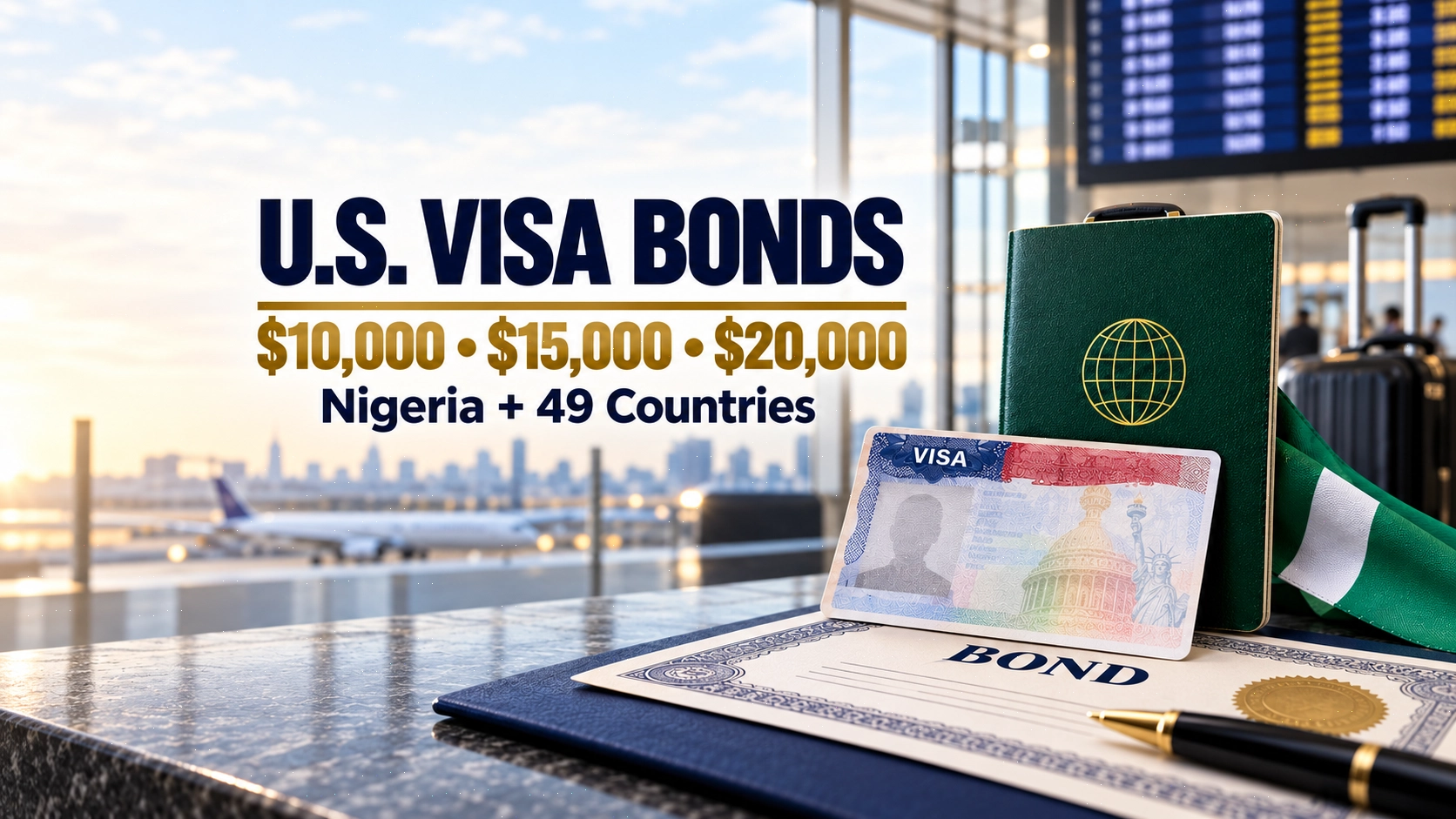
The U.S. Department of State (DOS) updated its official Countries Subject to Visa Bonds page on October 2, 2026. The consolidated list includes Nigeria and 49 other countries.
An otherwise-eligible person applying for a B-1, B-2, or combined B-1/B-2 visitor visa while traveling on a passport issued by a listed country must generally post a $10,000, $15,000, or $20,000 bond before the visa can be issued. Nigeria’s implementation date is January 21, 2026; the October update consolidated the list but did not create a new requirement for Nigerian applicants.
Important for Nigerian applicants: a separate B-1/B-2 visa restriction
Nigerian applicants must address a separate issue before reaching the visa-bond stage. Under Presidential Proclamation 10998 and DOS implementation guidance, the United States partially suspended visa issuance and entry for Nigerian nationals in several categories, including B-1, B-2, and B-1/B-2 visitor visas, effective January 1, 2026.
The proclamation generally applies to affected nationals who were outside the United States on its effective date and did not hold a valid visa on that date. It did not revoke visas that were valid on January 1, 2026. The proclamation also contains limited exceptions—for example, for lawful permanent residents and certain dual nationals applying with a passport from a country not subject to the suspension—and permits case-by-case national-interest exceptions.
A Nigerian applicant must first be outside the suspension’s scope or qualify for an applicable exception, including an approved national-interest exception. The applicant must also satisfy all other visa requirements before reaching the visa-bond stage. Posting a bond does not overcome the proclamation or create visa eligibility.
Who is subject to the visa-bond requirement?
The visa-bond requirement applies to a person who:
- Is a citizen or national of a listed country and travels on a passport issued by that country;
- Applies for a B-1, B-2, or combined B-1/B-2 visa; and
- Is otherwise eligible for the visa, including under any other applicable entry or visa restrictions.
The requirement applies regardless of where the person applies. Applying at a U.S. embassy or consulate outside the applicant’s country of nationality does not avoid it.
The program does not currently extend to immigrant visas, F-1 student visas, employment visas, or other nonimmigrant categories. A bond also does not guarantee visa issuance or admission to the United States. U.S. Customs and Border Protection makes the admission decision at the port of entry.
Countries and implementation dates
The DOS list identifies the following 50 countries:
| Implementation date | Countries |
|---|---|
| August 20, 2025 | Malawi; Zambia |
| October 11, 2025 | The Gambia |
| October 23, 2025 | Mauritania; Sao Tome and Principe; Tanzania |
| January 1, 2026 | Bhutan; Botswana; Central African Republic; Guinea; Guinea-Bissau; Namibia; Turkmenistan |
| January 21, 2026 | Algeria; Angola; Antigua and Barbuda; Bangladesh; Benin; Burundi; Cabo Verde; Cote d’Ivoire; Cuba; Djibouti; Dominica; Fiji; Gabon; Kyrgyz Republic; Nepal; Nigeria; Senegal; Tajikistan; Togo; Tonga; Tuvalu; Uganda; Vanuatu; Venezuela; Zimbabwe |
| April 2, 2026 | Cambodia; Ethiopia; Georgia; Grenada; Lesotho; Mauritius; Mongolia; Mozambique; Nicaragua; Papua New Guinea; Seychelles; Tunisia |
DOS may revise the list. Under the final Visa Bond Program rule, a newly added country ordinarily receives at least 15 days’ notice, while removal may take effect immediately.
How much is the bond?
The permitted amounts are $10,000, $15,000, or $20,000. The final rule indicates that consular officers are generally expected to select $15,000, with $10,000 or $20,000 used when the applicant’s circumstances and DOS guidance support a different amount.
There is no routine waiver application. In narrowly limited circumstances—such as certain U.S.-government travel or urgent humanitarian situations—a consular officer may recommend a waiver. The Assistant Secretary for Consular Affairs or a designee decides whether to approve it.
How does the bond process work?
Applicants should not pay a bond unless a consular officer provides specific instructions. If the applicant is otherwise eligible but must post a bond, the officer will provide instructions for completing DHS Form I-352 and paying through the official Department of the Treasury Pay.gov system.
A relative, friend, employer, or other third party may post the bond. The person named as the obligor on Form I-352 must be the person who makes the payment and will ordinarily receive the refund if the bond is canceled.
DOS warns that money submitted without official consular instructions will not be returned. Applicants should use only the payment link provided through the consular process and should be alert to anyone promising a visa in exchange for a bond payment.
How long may a bonded visa be valid?
Depending on the applicable reciprocity schedule, a bonded visa may be issued as:
- A three-month, single-entry visa;
- A three-month, multiple-entry visa; or
- A multiple-entry visa valid for up to 12 months.
Visa validity is not the same as the authorized period of stay. If the traveler is admitted, the Form I-94 record controls how long the person may remain in the United States.
Commercial-air entry and departure requirement
A bonded traveler must enter and depart through a commercial-air port of entry, including an authorized U.S. Customs and Border Protection preclearance location. Charter flights, general aviation, land borders, and sea ports do not satisfy the bond’s travel conditions.
This limitation matters when planning travel through Canada or Mexico, taking a cruise, or considering departure by land. A noncompliant itinerary may create admission, departure-record, and refund problems.
When is the bond returned?
A timely departure does not always trigger an immediate refund. Under the program’s cancellation rules, government records must establish compliance, and the timing depends on the circumstances:
- If the person never travels to the United States, cancellation ordinarily occurs when the visa expires.
- If the person makes a compliant visit and departs while the visa remains valid, cancellation ordinarily occurs when the visa expires.
- If the visa expires during a lawful stay, cancellation can follow a timely, compliant departure through a permitted commercial-air port.
- Cancellation can also follow a port-of-entry refusal when U.S. Customs and Border Protection cancels the visa, or a timely, compliant commercial-air departure after an approved extension or change of status.
The refund goes to the obligor. Travelers should not budget on receiving it immediately after a trip.
Because the government relies heavily on electronic arrival-and-departure records, travelers should keep their boarding passes, itineraries, passport records, Form I-94 information, and any notices involving an extension or change of status.
What may cause a bond breach?
Potential grounds for a breach determination include:
- A substantial violation of nonimmigrant status;
- An untimely application to extend or change status;
- Remaining beyond the authorized period of stay or, when an extension or change-of-status request was timely and properly filed, failing to depart within 10 days after its denial; or
- Filing Form I-589 for asylum or withholding of removal.
The reference to Form I-589 does not determine whether someone qualifies for asylum. It means that filing the form may affect the bond. Anyone considering an extension, change of status, asylum application, or significant change to the travel plan should obtain advice based on the individual circumstances.
Practical steps for affected applicants
Before a visa interview, an applicant from a listed country should:
- Determine whether another rule—such as Presidential Proclamation 10998 for Nigerian nationals—restricts visa issuance.
- Prepare evidence supporting the temporary purpose of travel, funding, ties abroad, and the intention to leave the United States as required.
- Decide who could post a $10,000, $15,000, or $20,000 bond if instructed.
- Send no bond payment until official consular instructions are received.
- If a bond is posted, plan both entry and departure through permitted commercial-air ports.
- Retain proof of travel and compliance until the bond is formally canceled and the funds are returned.
- Seek legal advice before changing status, extending a stay, filing Form I-589, or changing the travel itinerary.
Schedule an immigration consultation
The visa-bond program involves more than the ability to pay. Applicants must first establish visa eligibility, comply with any separate entry restrictions, and understand the bond conditions that continue after issuance.
If you need advice about a B-1/B-2 application, the visa-bond program, Presidential Proclamation 10998, or a consular instruction, schedule an immigration consultation with the Law Offices of Osas Iyamu, LLC.
- Toll-free: 1-800-974-6480
- Local office / WhatsApp: 352-237-2403
You may also review our nonimmigrant visa services and learn more about Immigration Attorney Osas Iyamu.
This article provides general information and is not legal advice. Immigration rules and country designations may change, and the application of visa-bond terms depends on the individual case. Reading this article does not create an attorney-client relationship.