Medani v. Trump: Court Orders 10 More Days for Certain DV-2026 Consular Cases

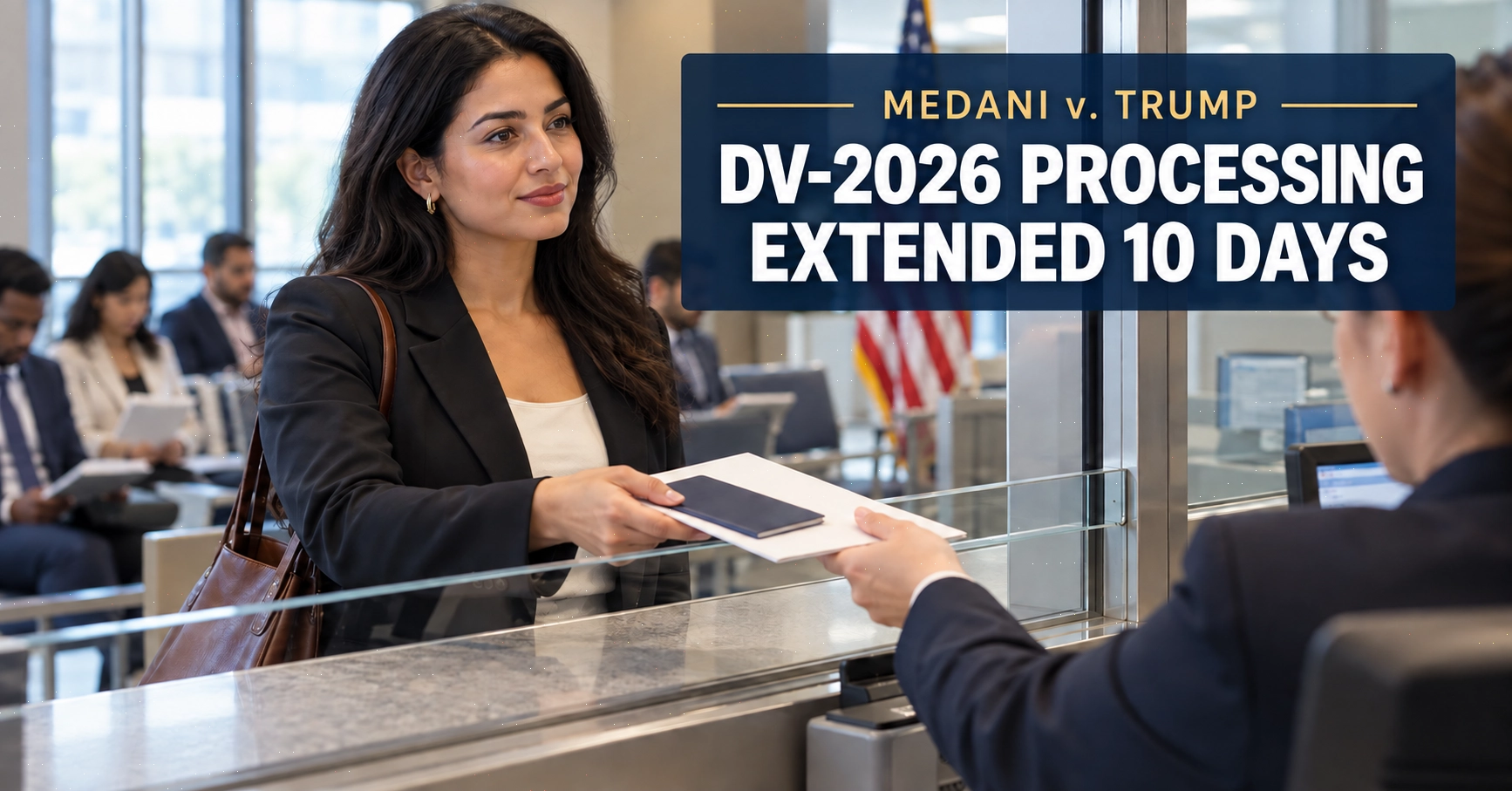
A federal court has ordered the U.S. Department of State (DOS) to continue processing certain Diversity Visa 2026 cases for 10 additional days after the ordinary September 30 deadline.
The relief is narrow. It applies to specified consular cases affected by DOS’s Diversity Visa pause or its separate 75-country pause. It does not extend every DV-2026 case, guarantee visa issuance, or expressly give USCIS additional time to approve adjustment-of-status applications.
Important timing update: On October 2, 2026, the court granted DOS a 10-day stay of the September 30 supplemental-relief order. According to plaintiffs’ class counsel, the additional DV-2026 consular-processing period is expected to run from October 11 through October 20, 2026. DOS has not independently published those dates on its public Diversity Visa guidance page. Because the litigation and implementation are moving quickly, applicants should verify the current docket and official communications before relying on the anticipated window.
What the court ordered
On September 30, 2026, U.S. District Judge Edward J. Davila issued a supplemental order in Medani v. Trump, No. 5:26-cv-06332-EJD (N.D. Cal.). The court directed DOS, to the extent practicable and in good faith, to take reasonable steps for 10 additional days to:
- reconsider DV-2026 applications refused solely under DOS’s DV pause or 75-country pause; and
- resume ordinary adjudication of covered pending DV-2026 applications.
DOS must continue filing compliance reports every Monday, Wednesday, and Friday until the additional adjudication period ends. The court scheduled a status conference for October 15, 2026.
The order concerns DOS processing at U.S. embassies and consulates. It does not direct consular officers to approve otherwise ineligible applicants, overlook missing evidence, or disregard legal grounds of inadmissibility.
Why the court provided additional time
The September 30 order enforces an August 28 preliminary injunction and class-certification order. That earlier ruling temporarily vacated three government policies restricting DV-2026 adjudication and required good-faith efforts to resume ordinary processing before the fiscal year ended.
The court later concluded that DOS’s response had materially frustrated the injunction. According to the supplemental order, DOS waited about 10 days before distributing worldwide compliance instructions. During that initial period, it did not schedule or conduct an interview or issue a Diversity Visa under the injunction, and some previously scheduled interviews were canceled.
Processing remained slow after instructions were distributed. The court reported an initial rate of approximately 83 cases per day, compared with about 230 per day in September 2025. The pace later increased, and DOS had processed 3,814 cases by September 28. Nevertheless, the court found that the initial delay deprived affected applicants of valuable processing time.
The court selected 10 additional days because that matched the period during which DOS had failed to issue worldwide instructions implementing the August 28 injunction.
Why post-September 30 processing is unusual
Under the ordinary DV-2026 program rules, an applicant generally must obtain the visa or complete adjustment of status by the end of fiscal year 2026. Selection in the Diversity Visa lottery does not itself guarantee a visa.
The government argued that continued processing after September 30 conflicted with Goodluck v. Biden, 104 F.4th 920 (D.C. Cir. 2024). In Goodluck, the D.C. Circuit rejected an order reserving unused Diversity Visas for issuance after the applicable fiscal year.
Judge Davila distinguished Goodluck. The Medani court declined the plaintiffs’ request to reserve approximately 40,000 unused visa numbers. Instead, it relied on a court’s inherent authority to enforce an injunction entered before the deadline after finding inadequate compliance with that injunction.
The court emphasized that Goodluck did not decide what remedy might be available when the government acts in bad faith or unduly delays compliance with a timely court order. The September 30 ruling therefore rests on the particular history of Medani. It is not a general rule extending Diversity Visa deadlines, and it is not binding appellate precedent.
Which DV-2026 cases may be covered?
The supplemental relief concerns the certified subclasses affected by the challenged policies. It specifically directs DOS to address:
- applications refused solely under DOS’s DV pause;
- applications refused solely under the 75-country pause; and
- covered pending consular applications requiring resumed ordinary adjudication under the August 28 injunction.
The order does not automatically cover every DV-2026 lottery entrant or selectee. It also does not eliminate the need for an available visa number or compliance with education, work-experience, documentation, medical, security, public-charge, and other admissibility requirements.
An applicant whose case was refused for an independent legal reason should not assume that Medani requires reconsideration. Coverage depends on the applicant’s case history and the stated reason for the delay or refusal.
Does the order extend USCIS adjustment-of-status cases?
No express extension appears in the September 30 order for DV-2026 adjustment applications pending with USCIS.
The supplemental motion focused on DOS’s compliance. The court noted that, according to the plaintiffs, USCIS had diligently complied with the August 28 injunction and therefore was not the subject of the request for additional relief.
Applicants with cases pending inside the United States should not assume that the 10-day consular-processing period also extends USCIS adjudication. They should review the governing orders and their individual filing history. General information about the domestic process is available on the firm’s adjustment-of-status service page.
What affected applicants should do now
Determine whether the order covers the case
Review whether the applicant is a DV-2026 selectee or derivative, whether the case was pending or refused, and whether DOS relied solely on one of the challenged pauses. Preserve refusal sheets, embassy emails, Entrant Status Check notices, and other communications showing the case’s procedural history.
Monitor official communications closely
Affected applicants should monitor email, the Diversity Visa Entrant Status Check system, and messages from the responsible embassy or consulate. Contact information should remain current. The response period for interview, medical, document, or passport requests may be extremely short.
Keep the case document-ready
Applicants should have passports, civil documents, required translations, police certificates, medical-examination materials, financial evidence, and requested supplemental documents available. Any response must remain accurate and complete despite the urgency.
Do not treat the order as an approval guarantee
The court ordered good-faith processing, not automatic approval. A consular officer may still refuse a case based on an independent legal ground, missing evidence, security checks, medical findings, public-charge concerns, or the absence of an available visa number.
Continue monitoring the litigation
An appeal, stay, new compliance order, or the October 15 status conference could change the practical effect of the ruling. Applicants should not rely solely on older DOS webpages because agency guidance may lag behind fast-moving court orders.
Practical significance of the ruling
The order creates a short opportunity for certain DV-2026 consular applicants who lost processing time because of the challenged pauses and delayed implementation of the August 28 injunction. Its significance is immediate but limited.
Schedule an immigration consultation
If your DV-2026 consular case was pending or refused under a pause imposed by DOS, schedule an immigration consultation with Immigration Attorney Osas Iyamu and the Law Offices of Osas Iyamu, LLC. The firm can review your case history and help determine whether the Medani orders may affect your matter.
Toll-free: 1-800-974-6480
Local office: 352-237-2403
Learn more about the firm’s U.S. immigration legal services and Immigration Attorney Osas Iyamu.
Disclaimer
This article provides general information and is not legal advice. Diversity Visa litigation and agency implementation can change quickly. Reading this article does not create an attorney-client relationship, and no result is guaranteed.