Belevich v. Thomas: Why Alleged Misconduct Did Not End Form I-864 Support Obligations

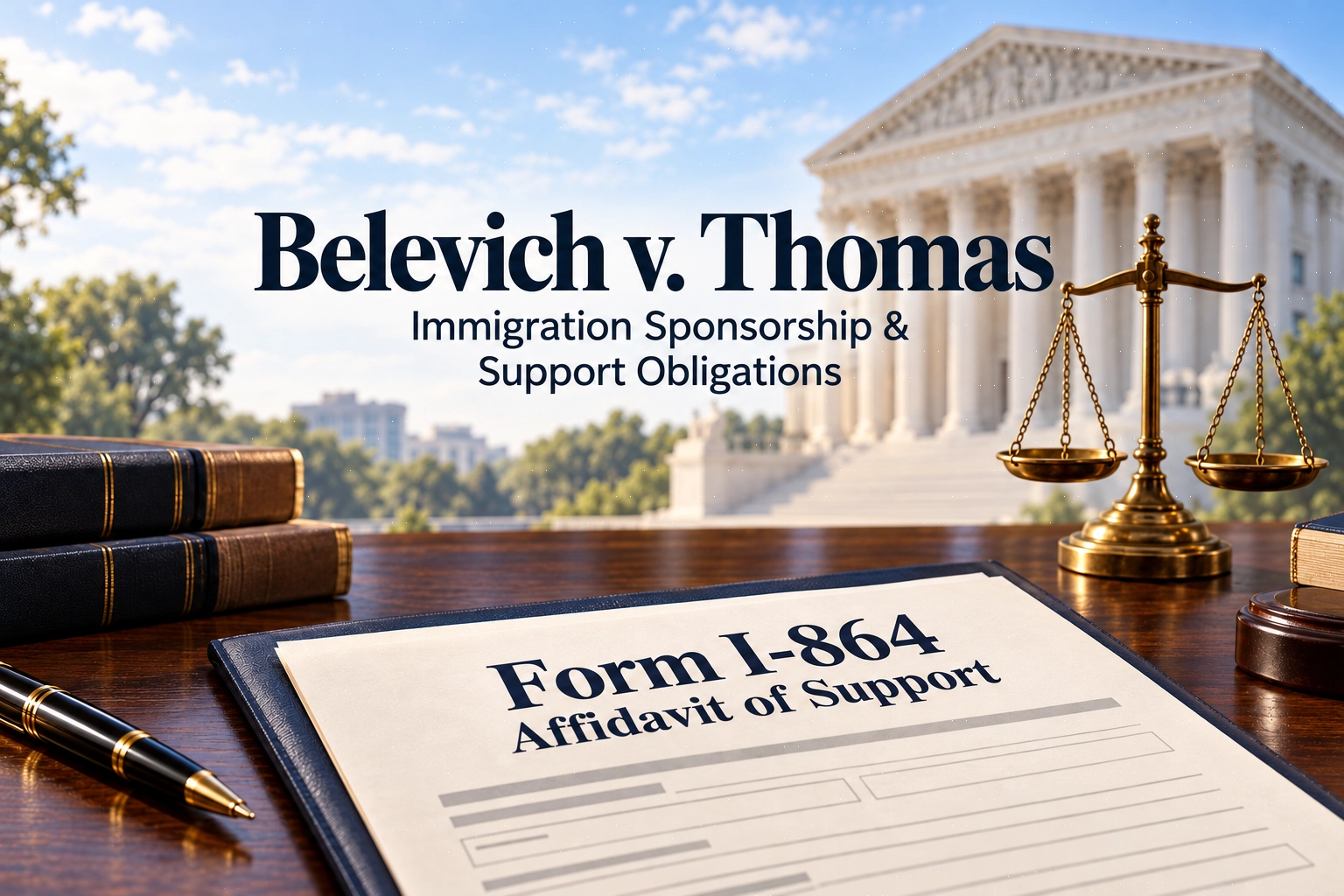
An immigration sponsor’s financial responsibilities can continue even after the family relationship breaks down. In Belevich v. Thomas, the Eleventh Circuit considered whether serious allegations against a sponsored immigrant allowed his sponsors to stop providing the support required by Form I-864.
The court ruled that the sponsors could not end their obligations through the defenses they raised. The decision shows why sponsors must look to the legal rules governing Form I-864 before assuming that divorce, family conflict, or alleged wrongdoing releases them from financial responsibility.
Case: Belevich v. Thomas, 17 F.4th 1048 (11th Cir. 2021), No. 19-14668. Court: U.S. Court of Appeals for the Eleventh Circuit. Decided: November 1, 2021. Disposition: Judgment affirmed in a published opinion.
How the family dispute became a support lawsuit
Valentin Belevich immigrated to the United States from Russia. His wife, Tatiana Kuznitsnyna, and her daughter, Klavdia Thomas, signed Form I-864 affidavits supporting his immigration.
By signing those forms, they agreed to provide the financial support required by federal law. Their affidavits specifically explained that divorce would not end that responsibility.
Belevich and his wife lived together in the United States for several years. While he was visiting his mother in Russia, his wife asked for a divorce. When he returned, she would not allow him back into their home. She later obtained a protection-from-abuse order and filed for divorce. Both sponsors stopped providing financial support.
Belevich subsequently faced criminal charges involving alleged sexual abuse of Thomas’s minor daughter and possession of child pornography. The court’s opinion described these allegations and charges; it did not determine whether he was guilty.
Belevich sued both sponsors in federal court, claiming that their refusal to provide support violated their Form I-864 commitments. The lawsuit therefore required the court to decide whether the sponsors’ financial obligations continued despite the family dispute and criminal allegations.
What Form I-864 requires
Form I-864 creates an enforceable financial commitment. Under INA § 213A, 8 U.S.C. § 1183a, a sponsor generally agrees to provide support sufficient to maintain the sponsored immigrant at 125% of the applicable federal poverty guideline.
The sponsored immigrant can bring a lawsuit to enforce that commitment. The government is not the only party entitled to seek enforcement.
The amount owed in a particular case depends on the applicable income standard, the period involved, and the relevant financial evidence. Signing Form I-864 does not mean that every amount an immigrant later requests is automatically payable. However, a sponsor cannot assume that the obligation disappears simply because the personal relationship has ended.
For additional background, see the firm’s explanation of affidavit-of-support enforcement and available remedies.
Why the sponsors believed they should no longer have to pay
The sponsors argued that Belevich’s alleged conduct should prevent him from enforcing the support obligation. They relied on three legal defenses:
| Legal defense | Explanation in everyday language |
|---|---|
| Unclean hands | A person’s own wrongdoing connected to a dispute should prevent that person from obtaining certain relief from a court. |
| Anticipatory breach | A party has shown that the party will not fulfill a contractual promise, potentially excusing the other side’s performance. |
| Equitable estoppel | A person’s statements or conduct, and another person’s reliance on them, may prevent the first person from taking an inconsistent position. |
The sponsors wanted the court to apply these principles to excuse their continued support. They also argued that the protection-from-abuse order or criminal charges made Belevich subject to removal from the United States and therefore ended their obligations.
How the courts ruled
The district court rejected the sponsors’ position. It first ruled that discovery into the pending criminal charges was irrelevant to the support issue before it.
The court later decided that the sponsors were liable without requiring a trial on that issue. This procedure is called summary judgment. A jury then determined damages.
The sponsors appealed. The Eleventh Circuit upheld the judgment, concluding that the governing statute, regulation, and affidavits did not allow the three defenses to terminate their support obligations.
Why the court rejected the sponsors’ arguments
The decision becomes easier to understand when the sponsorship promise is considered separately from the family relationship.
The sponsors made a commitment under federal immigration law. That commitment had its own rules about when support begins and ends. It did not make continued support dependent on a successful marriage or a good relationship between the immigrant and the sponsoring family.
The court identified three principal reasons for its ruling:
- Federal law controls the obligation. Although Form I-864 is a contract, federal law defines the sponsor’s responsibilities. The court could not use the contract and equitable defenses raised here to create additional ways of ending those responsibilities.
- The law specifies the events that end support. The court read those events as an exclusive list. It concluded that judges could not add an exception simply because continued support appeared unfair under the circumstances.
- The obligation serves a public purpose. The sponsorship arrangement is intended to prevent the immigrant’s financial needs from becoming a public burden. Alleged wrongdoing does not necessarily eliminate those needs. Releasing the sponsors on the grounds they asserted could shift the financial responsibility they accepted onto the public.
The court also explained that the affidavit imposes a support obligation without requiring a corresponding promise from the immigrant. It contains no promise of good behavior that makes support conditional on fulfilling that promise.
The judges acknowledged that the result could place a heavy burden on the sponsors. They nevertheless concluded that the law required it.
Why possible deportation was not enough
The sponsors’ removal argument involved a separate misunderstanding: being potentially removable is different from actually satisfying a rule that ends sponsorship.
Under 8 C.F.R. § 213a.2(e)(2), one terminating event requires the immigrant to lose lawful permanent resident status and leave the United States.
A criminal charge does not, by itself, establish that both events have occurred. Neither does a sponsor’s belief that the immigrant should be deported.
For example, if a sponsored immigrant is arrested while still living in the United States, the arrest alone does not establish that the immigrant has lost permanent resident status and departed. The sponsor must identify an applicable termination rule and determine whether its requirements have actually been met.
Other terminating events include citizenship, sufficient qualifying Social Security work credits, and death. Different rules address certain new grants of permanent residence in removal proceedings. See when affidavit-of-support obligations end for the complete explanation.
What the decision did not settle
The court did not hold that every possible defense to an I-864 claim must fail.
In footnote 2, it left open whether a sponsor could challenge an affidavit as invalid from the beginning because it was obtained through fraud or duress. Duress generally involves improper pressure or coercion.
There is a difference between arguing that later misconduct ended an existing obligation and arguing that the affidavit was never valid in the first place. The court rejected the defenses before it but did not decide that separate question about original validity. A sponsor cannot treat this reservation as a guarantee that a fraud or duress defense will succeed.
The amount of unpaid support is also a separate question. Even when sponsorship continues, the parties may dispute the immigrant’s income, support already provided, or the period for which payment is sought.
For example, an immigrant’s earnings may affect whether there is a financial shortfall during a particular period. That calculation does not necessarily determine whether the underlying sponsorship obligation has ended. Income records, payment records, and the signed sponsorship forms are therefore important to both sides.
The decision’s significance and later developments
Belevich v. Thomas, 17 F.4th 1048, was decided on November 1, 2021. As a published Eleventh Circuit decision, it is binding precedent for federal district courts in Florida, Georgia, and Alabama. Courts elsewhere may consider its reasoning as persuasive authority. The official opinion contains the court’s full analysis.
Rehearing was denied on December 20, 2021. The Supreme Court denied review on May 31, 2022, leaving the judgment in place. That denial was not a Supreme Court ruling approving the decision’s reasoning. The Supreme Court docket records those proceedings.
A later case illustrates why earlier court proceedings also matter. In Ramgoolam v. Gupta, No. 25-1676 (6th Cir. Apr. 2, 2026), the Sixth Circuit applied Michigan’s rules to bar an I-864 claim that could have been raised during divorce proceedings. This is called claim preclusion: an earlier judgment can prevent a later lawsuit. The court distinguished Belevich; it did not hold that divorce itself ends sponsorship. This decision is persuasive, not binding, in the Eleventh Circuit and illustrates why related divorce judgments and earlier litigation need careful review.
Schedule an immigration consultation
Immigration Attorney Osas Iyamu at the Law Offices of Osas Iyamu, LLC can review your sponsorship documents and immigration history and explain the responsibilities associated with the forms signed. If you need to sue a sponsor for financial support—or defend against such a lawsuit—you may need an attorney experienced in Form I-864 enforcement litigation.
Schedule an immigration consultation or call Toll-free: 1-800-974-6480 or Local office: 352-237-2403.
This article provides general information, not legal advice. The appropriate analysis depends on the facts and governing law. Reading this article or contacting the office does not create an attorney-client relationship.
Reviewed October 12, 2026.